

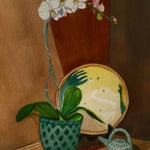
Assignment #4: Still Life with Potted Plant. Take a relatively small potted plant, with or without flowers, either in a plain terra cotta pot or something more decorative. Create a pleasing and balanced design by incorporating two more objects – a piece of fruit, a shell, a stone, for example – into the composition. The two objects should be subordinate in size to the plant and vary in size relative to each other to add interest. --from Braldt Bralds
The Process: I set up a composition incorporating three elements: an orchid in a decorative pot, a small celadon teapot and a ceramic Asian plate in plate stand. The photograph, shown on the left, was taken outdoors against an adobe wall. After transferring the image onto watercolor paper, I added graphite details and shadows to the pot and the wood-grain tabletop. I applied liquid frisket to mask the white orchid blossoms and some of the lightest highlights on the pot, plate and rim of the teapot. Using a mixture of Burnt Sienna, French ultramarine and sepia, I applied several washes to the background walls and a lighter wash to the tabletop. To create the celadon color of the teapot, I used a mixture of Naples yellow and Cobalt blue. I applied a light wash of the celadon mix to the teapot and a second wash after removing the frisket. After adding more Cobalt blue to the mixture, I applied several washes of color to the decorative pot, adding dark shadows under the rim and the diamond-shaped insets; the same color was used in the abstract design on the plate. The plate was completed using a light wash of Naples yellow with a wash of Burnt Sienna along the rim. Lastly, I painted the leaves and flowers of the orchid plant after removing the frisket. By adding a bit of Gum Arabic to the shades of green paint, the leaves took on a glossy glow. The delicate orchid flowers were completed with touches of white gouache, a mixture of Alizarin crimson and gouache, and touches of grey to outline the pedals, while leaving some of the white paper show through as the brightest highlights.
The Critique: This was my most successful work of the four assignments. It is also my most realistic painting, a clear departure from my typical loose, abstract style. The painting is successful in part because of its composition, an orderly arrangement: the orchid provides a strong center of interest and there is good variation in the proportions and shapes of the three elements. The painting incorporates a good degree of light and dark elements. The orchid pedals could be set off further by darkening the shadowed wall.
Lesson Learned: The elements of design are the building blocks; they provide the structure for a successful painting. Values create gradation in light and contrast; without them, the painting would be flat.
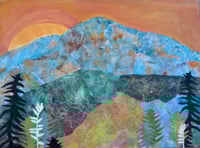
Sunrise Over the Sangres, mixed media on canvas, 30 x 40
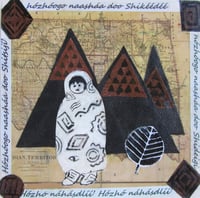
Walking in Beauty, mixed media, 8x8. See more of my Spirit of the Earth Series on the Native Abstractions page. In permanent collection of the Museum of Collage and Assemblage.
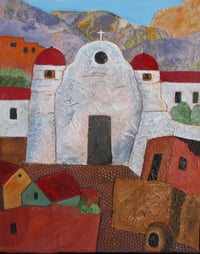
Mission Church, mixed media on canvas, 20 x 16. See others on my Latest Works page.
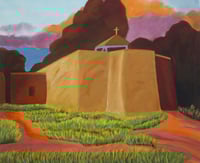
Mission Church, oil on canvas, 24 x 20. See more of these works on Latest Works page.
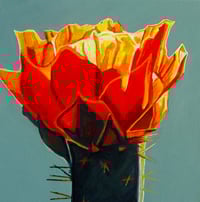
Firecracker Cactus
Acrylic on canvas,
10 x 10, See more on the "Small Works" page.
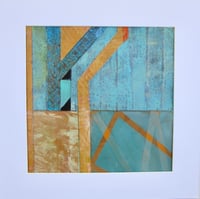
Pastiche I, collage, 12x12 image size, 16x16 matted. See more on the Pure Abstractions page.
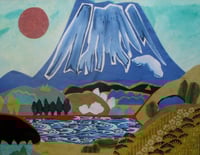
Flower Moon 雪国
Collage, watercolor,
20 x 16, matted. See more Japanese-inspired works on my Asian Abstractions page.

San Geronimo Runners,
36 x 12. See more on Native Abstractions page.
Write a comment